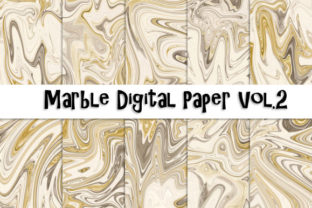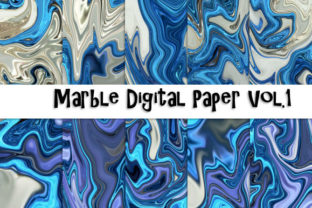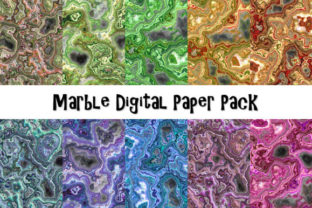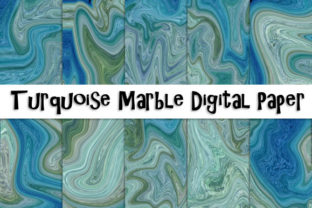
Turquoise Marble Digital Paper
If you’ve ever stared at a blank design canvas—whether it’s for a wedding invitation, a boutique clothing label, or even a classroom handout—and wished for something elegant but effortless, Turquoise Marble Digital Paper is the quiet solution you didn’t know you needed. It’s not just another background texture. It’s a high-resolution, seamless digital resource built for real work: 10 distinct marble patterns, each delivered as a JPG file at 3000×3000 pixels, ready to drop into Canva, Photoshop, Illustrator, Cricut Design Space, or even your home printer.
What It Actually Is (and What It’s Not)
Turquoise Marble Digital Paper is a collection of photorealistic, digitally rendered marble textures—cool-toned, veined, softly luminous—with subtle variations in grain, depth, and translucency. These aren’t AI-generated abstractions or oversaturated stock filters. They’re crafted to mimic natural stone: calm, grounded, and quietly luxurious. Each pattern repeats seamlessly, so you can tile them across banners, fabric prints, or large-format posters without visible edges or awkward breaks.
It’s not a font. It’s not a plugin. And it’s not locked behind a subscription. It’s a set of files—simple, portable, and instantly usable. That means no learning curve, no compatibility headaches, and no waiting for renders or downloads from cloud libraries.
Where It Fits Into Real Creative Work
Think about the last time you designed something that needed to feel intentional—not trendy, not loud, but *considered*. Turquoise Marble Digital Paper works where color alone falls short and photography feels too literal. Its cool, mineral richness adds dimension without competing with text or photos. That’s why it shows up in places you might not expect—but always makes sense:
- Wedding invitations: Print on luxe cardstock, layer under foil-stamped names, or use as a subtle background in digital e-vites. The soft turquoise tones complement sage, ivory, dusty rose, and charcoal—no color-matching stress.
- Small business branding: A local ceramics studio uses one pattern as the base for their logo lockup on Instagram bios and packaging labels. A wellness coach overlays her session schedule on another, then prints it as a tear-off desk calendar for clients.
- Scrapbooking & memory keeping: Unlike busy floral papers, these marble textures provide breathing room around photos—especially baby announcements, graduation collages, or travel journals where you want the story, not the background, to hold attention.
- Fabric and apparel printing: Upload directly to print-on-demand services like Spoonflower or Printful. One user tested it on linen napkins for her catering business; another screen-printed a simplified version onto organic cotton tote bags for a sustainable lifestyle brand.
- Educational materials: Teachers embed a muted pattern behind student worksheets to reduce visual fatigue—especially helpful for neurodivergent learners who find stark white pages overwhelming. It’s subtle enough not to distract, but present enough to ground the eye.
Why Size and Seamlessness Matter More Than You Think
The 3000×3000 px resolution isn’t overkill—it’s practical. At 300 ppi, that’s roughly 10×10 inches in print: enough for an A4 invitation suite, a full-page newsletter header, or a desktop wallpaper that stays crisp on Retina displays. And because every pattern is truly seamless, you can scale it to cover a 48-inch-wide fabric panel—or shrink it down to a 2-inch square icon background—without pixelation or repeating “jumps.”
This matters when you’re working across formats. Say you design a logo using one pattern as a watermark background. Later, you adapt that same logo for a social media banner, a business card, and a sewn patch. With non-seamless textures, you’d need to manually crop, reposition, or rescale each time—risking inconsistency. Here, you apply once and trust it holds up.
Who Benefits—and How Their Needs Differ
A freelance graphic designer might license Turquoise Marble Digital Paper to build a custom brand kit for a client launching a coastal spa. She values the consistency across deliverables—and the fact that she can legally use it commercially without tracking usage limits.
A parent organizing a child’s birthday party might download it to create DIY cupcake toppers and favor tags. For them, ease is everything: drag, drop, print, cut. No layers to manage, no transparency issues, no “this only works in Procreate” surprises.
An educator preparing hybrid lesson materials uses it to differentiate worksheet versions—soft marble for reading comprehension, slightly bolder veining for math problem sets—giving students visual cues without changing fonts or layout logic.
Even bloggers and content creators use it behind quote graphics or podcast episode thumbnails. The marble texture adds tactile warmth to otherwise flat digital spaces—making quotes feel more human, less algorithmic.
Things to Keep in Mind Before You Use It
Not every turquoise marble pattern works for every purpose. If you’re printing on dark fabric, go for patterns with higher contrast veining. For laser-printed stationery, avoid the lightest variants—they can look washed out on uncoated paper. And if you’re layering text, test readability early: subtle serif fonts often pair better than thin sans-serifs against fine grain.
You’ll also want to check your software’s color profile. JPGs don’t carry embedded CMYK profiles, so if you’re sending files to a commercial printer, convert your final layout to CMYK *after* placing the marble image—not before. Most home printers handle RGB fine, but professional presses need that shift.
And while all 10 patterns are royalty-free for personal and commercial use, double-check your platform’s terms if you’re uploading to marketplaces like Etsy or Creative Market. Some require attribution—even for digital papers—and others restrict resale of unaltered files. When in doubt, tweak the brightness, add a faint overlay, or combine two patterns using blending modes. That small edit makes it unmistakably yours.
It’s Not About Decoration—It’s About Intention
Turquoise Marble Digital Paper doesn’t shout. It settles. It gives weight to a handwritten note, elegance to a price tag, and quiet confidence to a startup’s first website banner. It’s the kind of resource people return to—not because it’s flashy, but because it solves small, recurring problems: how to make something feel handmade without spending hours, how to unify a brand across mediums without hiring a designer, how to add sophistication without adding complexity.
Whether you’re printing 50 wedding invites or designing a thousand digital assets for a course launch, it’s the background that lets the foreground shine. And sometimes, that’s the most useful thing a digital paper can do.